
Yesterday (the 17th), Chairman Terry Gou visited Banqiao Cihui Temple in the morning to pay respects to Mazu, mentioning that Mazu had recently appeared to him in a dream and told him "Mazu wants me to step forward." He then rushed to Tamsui Wusheng Temple, where the temple master took him to a private room to secretly impart divine guidance. In the afternoon, he visited the Kuomintang headquarters to receive an honorary citation awarded by KMT Chairman Wu Den-yih. These series of political moves sent shockwaves through the political arena, and online discussion exploded on Facebook, making it the most discussed single news story of the day.
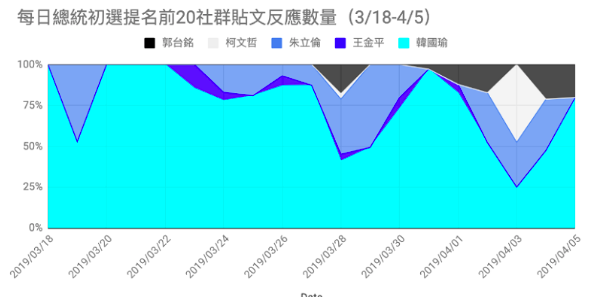
In fact, Terry Gou had been making frequent moves since late March, opening official accounts on both Facebook and LINE to gather supporters and build rapport. During the spring break, the news of Gou running for president was fiercely debated on social media. Although he had not officially announced his candidacy as of today, the data shows that discussion of Gou entering the race from late March to early April did indeed suppress Mayor Han Kuo-yu's online discussion momentum.
While Gou's actions have been dramatic, they have not been without precedent. The Tainan Nankunshen Daitian Temple draws an annual divination lot to foretell Taiwan's national fortune and pray for the country's peace and prosperity. Wang Jin-pyng, Honorary President of the Chinese Taoist Federation, cryptically mentioned "conditions have ripened" both the first time he ran for Legislative Yuan Speaker and more recently when he announced his presidential bid. Su Tseng-chang also made a special visit to Baoan Temple to report to the God of Medicine when running for New Taipei City mayor. Taiwan's folk religion, centered on temples, draws crowds and money alike, and has long been contested ground for neighborhood chiefs and local representatives, with deep and complex ties to the political world.
We observed the Facebook behavior data of 18 deities across four user actions — posting, liking, sharing, and commenting — and share the findings here. If a deity can already generate online discussion on their own, they can surely help create buzz for a candidate as well.
The God of Wealth and Mazu Are Hot Topics: Welcome the God of Wealth at New Year, Chase Mazu in April
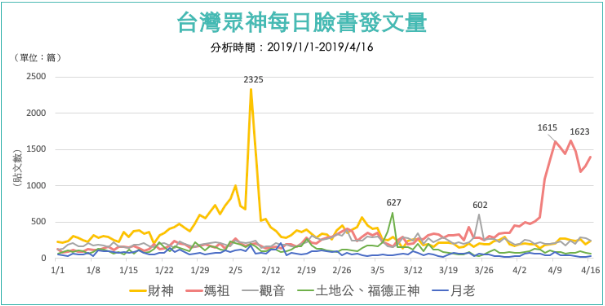
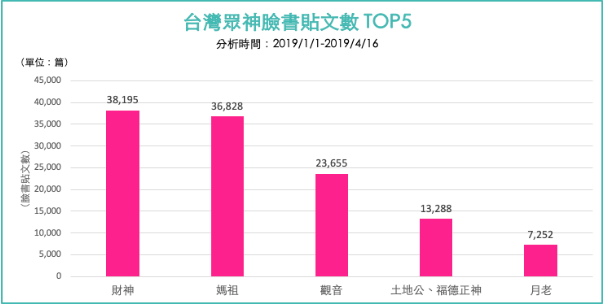
To generate discussion on Facebook, one must first post — only then can subsequent interactions such as likes, shares, and comments follow. Looking at daily post volume in Figure 2 to observe the active discussion levels surrounding Taiwan's deities, the God of Wealth on the fourth day of the Lunar New Year (February 8), the Earth God's birthday (March 8), Guanyin's birthday (March 25), and Mazu's pilgrimage in April all drove spikes in activity. The God of Wealth's highest single-day post count exceeded Mazu's by 702 posts, and with 38,000 total posts, the God of Wealth held a firm first place in overall post volume (Figure 3).
Both Guanyin and the Earth God recorded their peak single-day post counts on their respective birthdays, with relatively small gaps between them. However, looking at total post volume as a measure of overall community discussion, Guanyin, the Earth God, and the God of Matchmaking each saw nearly half the volume compared to the rank above them.
Politicians Who Join the Dajia Mazu Pilgrimage Get Noticed
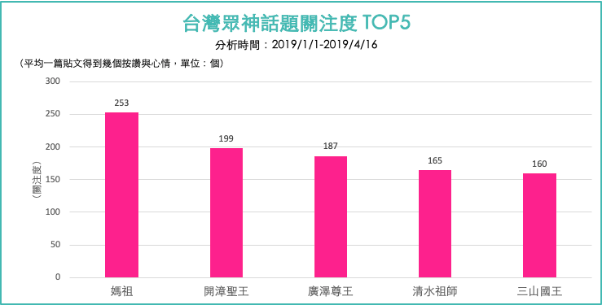
The simplest interaction on Facebook is a like. Interpreting the use of likes and other emoji reactions as an indicator of audience interest in a topic, Mazu topped the rankings with an average of 253 likes per post, followed by Kaizhang Shengwang, Guangze Zunwang, Qingshui Zushi, and Sanshan Guowang — with relatively small gaps among the top five. Although the God of Wealth generated a high volume of posts, the average number of likes per post was only 102, just 40% of Mazu's figure.
In terms of raw like counts, while Mazu's total post count was slightly lower than the God of Wealth's, Mazu's total likes of 9.3 million far outpaced the God of Wealth's 3.91 million. By this measure, Mazu's Facebook popularity appears to surpass the God of Wealth's, also reflecting that Mazu worship is more widespread. Of Mazu's 9.3 million likes, 47.4% came from the Dajia Mazu Pilgrimage between April 7 and April 16, making it almost certain that Mazu's timing in appearing to Terry Gou in a dream was no coincidence — it was the perfect moment. Wherever Mazu goes, devotees follow; wherever devotees go, votes follow. It is no wonder that when the Dajia Mazu sets out on her pilgrimage, presidents, mayors, legislators, and councilors all scramble to follow in her wake.
The God of Wealth Mobilizes Followers: Devotees Are Happy to Share
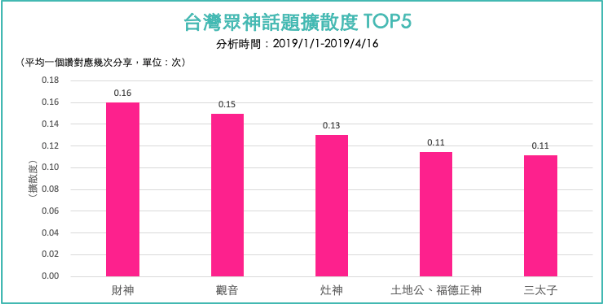
A like alone is not enough. When devotees are willing to share a post on their own Facebook pages, it can be seen by far more people. The ratio of likes to shares therefore serves as an indicator of the virality of topics related to Taiwan's deities.
In terms of virality, the God of Wealth topped the chart with a ratio of 0.16 shares per like; Mazu, by contrast, dropped off the chart with a ratio of just 0.07. Although the God of Wealth does not attract as much attention as Mazu, devotees' motivation to share God of Wealth-related content is exceptionally high — perhaps because sharing is, for God of Wealth devotees, the equivalent of inviting the deity home to bless the household. Guanyin, the Kitchen God, the Earth God, and Nezha followed in second through fifth place with small differences between them.
Wenchang, Guan Yu, and Nezha Generate High Discussion — Closer and More Familiar to the Public
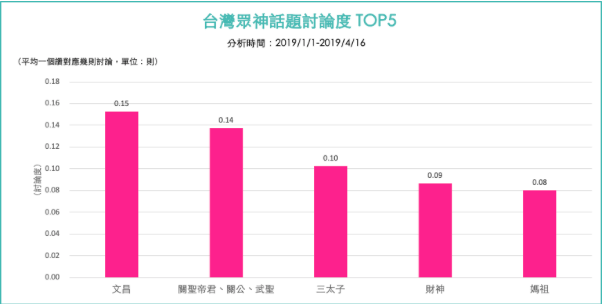
Using the ratio of comments per like as an indicator of discussion engagement, Wenchang Dijun topped the rankings with 0.15 comments per like. Many temples, even those whose main deity is not Wenchang Dijun, still offer the service of lighting a Wenchang lantern, as the pursuit of success, fame, and clarity of mind and vision is a universal aspiration.
Guan Yu, the righteous and loyal general from Romance of the Three Kingdoms, is also one of the deities most familiar to Taiwanese people, coming in second with 0.14 comments per like. Nezha, who in recent years has cultivated a modern image, also ranked third with a discussion rate surpassing both the God of Wealth and Mazu.
With Terry Gou Backed by Mazu and Guan Yu, Han Kuo-yu Should Seek a Dream from the God of Wealth
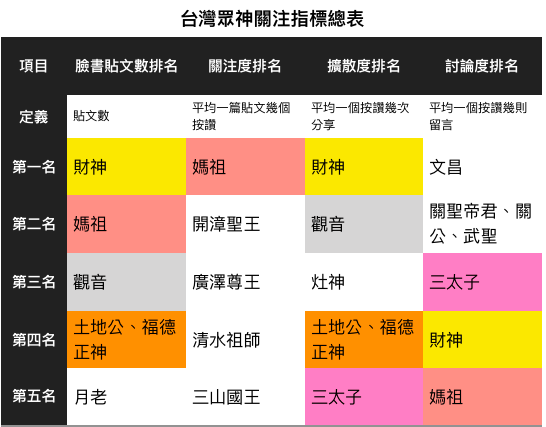
Combining the results from Figures 2 through 5, the God of Wealth and Mazu each dominate three of the four rankings. Mazu ranks first in audience attention and has 2.3 times as many total likes as the God of Wealth, giving her broader mass appeal. However, the God of Wealth's devotees are highly motivated to share content, which can help break through social echo chambers.
As both Terry Gou and Han Kuo-yu — both associated with an image of economic prowess — emerge as rising stars of the Kuomintang, their supporter bases may overlap. At least from Figure 1, as soon as news of Gou entering the presidential race began to spread, it suppressed Han Kuo-yu's online discussion. With Gou backed by Mazu, perhaps Han Kuo-yu — whose concrete political image is built around "getting rich" — should consider cultivating a relationship with the God of Wealth.
Article from Sway Strategy, authored by Sway Strategy researcher Hsiao Ya-yun.